
CSUSM physicist publishes PNAS study on ice and solar system origins
Research led by Gerardo Dominguez shows energetic particles can alter oxygen isotopes in ice at temperatures near absolute zero.
By Florence Ellis ·
A physics professor at California State University San Marcos has published a study in the Proceedings of the National Academy of Sciences, a peer-reviewed journal founded in 1915. The paper, titled “Mass-Independent Oxygen Isotope Fractionation Driven by Energetic-Particle Irradiation of Icy Solids,” appeared last week. It reports on experiments conducted at temperatures as low as 10 kelvin, approximately minus 263 degrees Celsius.
Gerardo Dominguez, who has taught at CSUSM since 2011, led the research team. The group included CSUSM undergraduate students, physics lecturer Caroline Caplan, and scientists from UCLA and Washington University in St. Louis. They investigated how energetic particles affect the chemical composition of icy minerals in space-like conditions.
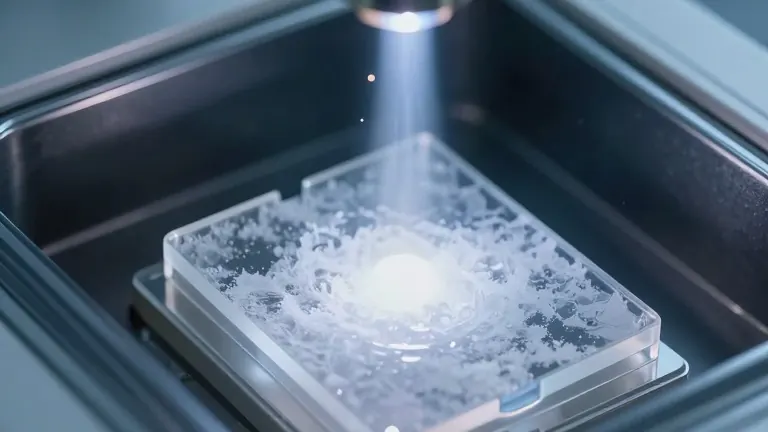
The team used laboratory equipment to simulate the cold, low-pressure environment of interstellar space. They placed water ice on silica and alumina surfaces and bombarded the samples with energetic electrons. To measure the resulting changes, they used secondary ion mass spectrometry at UCLA. This technique determines the isotopic composition of materials.
The experiments revealed that energetic particles striking icy mineral surfaces can change the proportions of different oxygen atoms. This process, known as mass-independent oxygen isotope fractionation, was previously associated mainly with gas-phase chemical reactions. The new findings show that similar changes occur when particles strike solid minerals coated in water ice at extreme cold.
Dominguez noted that the radiation alters the mineral surfaces in ways that persist after exposure stops. If water ice later contacts these altered surfaces, additional chemical reactions can occur that would not normally happen at 10 kelvin. He described this as a chemical memory retained by dust grains.
“It means a huge deal to me,” Dominguez said. “It’s very difficult to get a paper accepted into PNAS. I’m proud of this paper and its findings because they have broad implications for a number of fields, including physical chemistry, astrophysics and planetary science. It’s a major contribution to science. In some ways, it represents a synthesis of my graduate school training and postdoctoral work.”
The research addresses a mystery in planetary science regarding why the sun and rocky planets have different oxygen isotope ratios. Dominguez said the study identifies a new mechanism that may have influenced the chemical signatures of planetary materials millions of years before planet formation. One student on the team, Lauren Tafla, completed a doctoral program at UCLA and now works at NASA’s Johnson Space Center in Houston.
Source: CSUSM News · original report published